Red Bull Racing chief engineer Paul Monaghan says that the RB20 sidepod inlet modification for Barcelona represents a “valid pursuit”.
In the FIA document that outlines bodywork changes, Red Bull noted that – “with potentially warm races ahead in Europe, the sidepod inlet geometries have been revised based upon simulation results to exploit higher pressure inlet air for greatest cooling efficiency and therefore least number of exit louvre openings.”
Monaghan explained that reducing the size of the exits represents a useful gain in efficiency.
“You start opening holes in the back of the bodywork, and you spill tumbling dirty air, as we call it, towards the beam wing, floor edges, that type of thing, and it hurts,” he noted.
“And the sensitivity to aerodynamics around here, it’s high enough that you’re arguing for a grid slot or two if you get it wrong.
“Don’t forget, we’re in a tight fight with these guys, and our scope to change the car is not as free as it perhaps used to be.
“So wherever we can make a gain, particularly circuits like here and Silverstone, and off we go. Yes, it’s valid.”
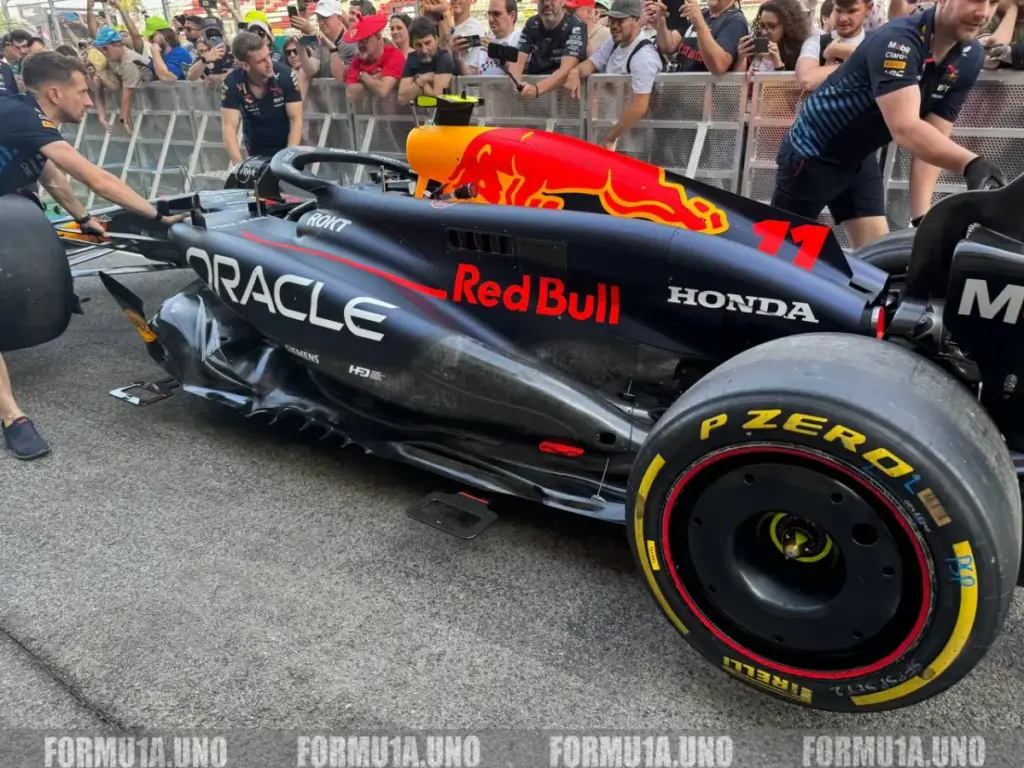
Monaghan stressed that the team’s bodywork choices are always related to the temperature conditions at each weekend.
“The engine’s got a finite temperature at which you can operate,” he said. “So a day like today, a little bit open. If Austria is 30 to 31 degrees, and it’s 1000 metres above sea level, it’ll be wide open. At Silverstone, we’ll see what we get in our British summer!
“But it’s a valid pursuit. And the effort that goes into sort of re-sculpting the bodywork to get better efficiency at the inlet for a lesser exit it’s hard work, it’s diligent, and it’s a reasonable magnitude of upgrade.
“And we’ll see if the improvement is good enough to see us right on Sunday.”
He added: “It should be better everywhere. Whether we’ve got enough here to get through a warm Hungary, it’s 35 degrees and relatively slow speed, we’ll find out. And then we’ll see what we need to do.”
Monaghan confirmed that the team is still trying to improve the RB20’s performance over kerbs and bumps, which was a particular issue in Monaco.
“We intend to try and address any performance limitation in the car, so we don’t do one in deference to another,” he said.
“You see the bodywork, you don’t see what we bury inside it. If we keep it away from prying eyes.
“That’s an ongoing development, and we will chip away in whatever magnitude we can achieve, race by race. So this place might not be so bad for us. We’ll see what we can do. Hungary’s got a few [kerbs], hasn’t it? Austria’s got plenty of kerbs we’ve always enjoyed.
“We’re not resting, and we just have to have a car that rides adequately to get us around the lap. If we’re quickest, okay, [that] doesn’t mean we won’t stop. We’ll see if we can make more.”

Monaghan also admitted that it’s getting harder to find gains under the current regulations. An additional restriction is that teams have to decide how to split their R&D resources between this year’s car, the 2025 iteration, and the brand-new model due to race in 2026.
“The rules are restrictive; the budget cap is a bit restrictive. I can moan about that for eternity, and I’ll bore us all senseless. But it’s also we potentially are asymptoting a bit on these regulations.
“And then we’ve got to decide as a team how much we carve up for 2025 and then get ourselves ready for ’26.
“So people way cleverer than I will find things to improve this car. And then it’s a case of, can we actually execute them, put them on the ’24 car, into ’25 and still be able to get a ’26 car done?
“So that’s our business, our choice, our trade. And there are nine other people in the pit lane having the same dilemma.”