The new Ferrari has undergone its first track test on demo tyres, completing the first of two annual filming days granted by the FIA to each team. The SF-25 completed 200 km on its home track with both drivers. Ferrari confirmed to us that the test went smoothly, without any negative surprises.
The team’s work
Fred Vasseur’s technicians have started the normal process of understanding the SF-25. They have done so by obtaining the data necessary for preliminary checks: installation data, correlation, systems, electronics, procedures and kinematic controls.
In the same way, the drivers have finally verified the ergonomics and functions of their cockpits on track.
After the TPC tests, Hamilton had asked for some changes, which were swiftly implemented. Other small details were requested in the evening at Fiorano and will be perfected for Bahrain. However, these are relatively minor – there are no strong differences with Leclerc’s settings.
“I’m not at the level I want yet and I know it. Everything is different, I have to work on it a lot,” Lewis admitted after the test.
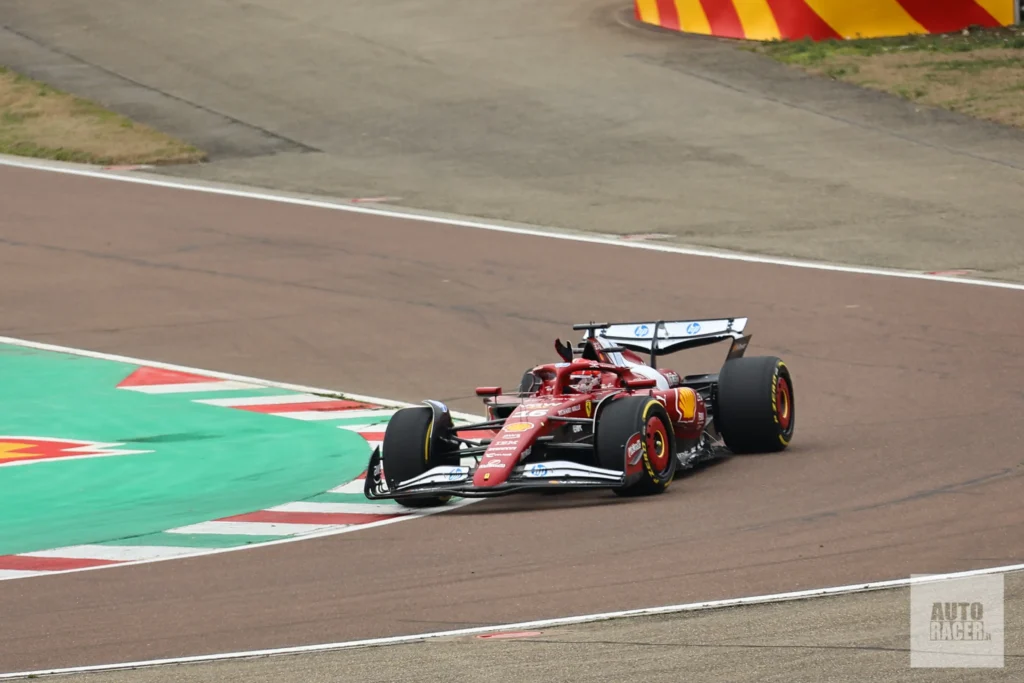
Leclerc satisfied with the SF-25, but remains cautious. Hamilton still learning on initial runs
The work developed by the drivers was not identical. Leclerc, as the established driver, was already able to push, although pure performance was not the priority.
Hamilton worked fundamentally to gain more confidence and refine his requests. In the end, both gave positive feedback from their track time.
Engineers indifferent to lap-times, why?
The Fiorano track is never an absolute test bed in terms of performance with this generation of cars.
Even less so when the demo tyres and overall conditions are far apart from each other from year to year. Neither program was really pushing for them, the engineers manage to put together their puzzle of information without any need to see them at Fiorano.
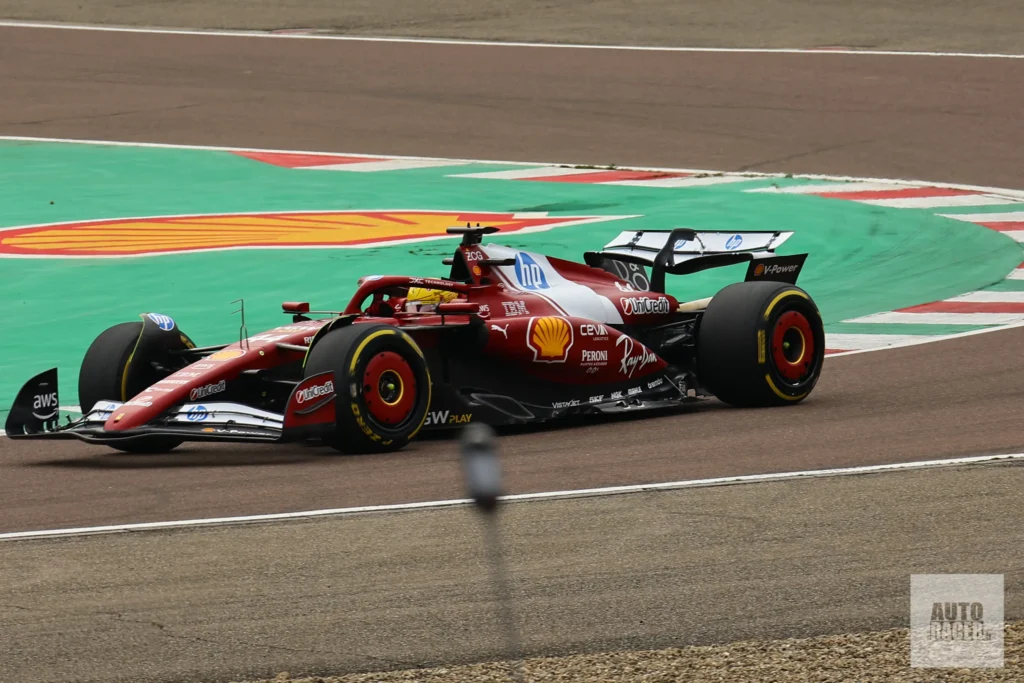
The Ferrari SF-25 has been revealed in its new medium-downforce specification, which is the one we will see in Bahrain.
If the front wing was a very close evolution of the Austin specification, one of the most visible innovations was the rear wing group. The main plane has been completely redesigned in a V shape, in the wake of McLaren but with a nod to the Alpine idea of central accumulation of the load.
It is equipped with a much more efficient DRS device than the old car where there was a tendency to unload the beam wing using a more loaded fixed profile. On certain tracks that ‘do-it-all’ wing posed limits in qualifying due to a less powerful DRS.
The SF-25 in terms of configurations should work in reverse, through the appropriate beam wing gradations. This totally takes up the concept seen on McLaren and before that on Red Bull but with a specification that appears to be perfected on the medium load.